Basic HTML Version



I
n Lisburn’s seventeenth-century Market House,
two women spend their days weaving the old-
fashioned way. They practice this storied craft on
two humble hand looms and a Jacquard loom that
were first used to create fabrics in Queen Victoria’s time.
The Northern Ireland city on the River Lagan is
known far and wide as the birthplace of Ireland’s linen
industry, so it is only fitting that this work produced for
the Irish Linen Centre & LisburnMuseum is what keeps
interest in the craft alive.
“Irish linen is an emblem of romantic Ireland,” says
curator BrianMackey. “There’s somethingmagical about
taking the fiber of a plant and watching it bloom into a
thing of beauty.”
During any given year, some 50,000 visitors from
around the world come to see history being woven before
their very eyes. The women, who trained for three years,
produce damask napkins in a half dozen traditional pat-
terns, as well as the centre’s signature piece in a modern
flax-flower design.
They begin by making a drawing and transferring
the lines to graph paper. A machine copies the pattern
and punches pinpoints into stiff, bulky paper cards to
create an intricate template that is as dainty as a doily.
It takes 1,500 cards to yield one simple napkin. After the
cards are sewn together by hand, they are inserted into
an antique Jacquard loom that weaves the weft pattern
into damask cloth. “Ours is an educational endeavor,”
Brian explains. “Aside from somemodernmodifications,
we do it just as it was done in its heyday.”
The centre’s other exhibits display the variety and
versatility of Irish linen. These include a 1960s pleated
wedding dress by Sybil Connolly, the renowned designer
who made the gown worn by First Lady Jacqueline
Kennedy for her White House portrait.
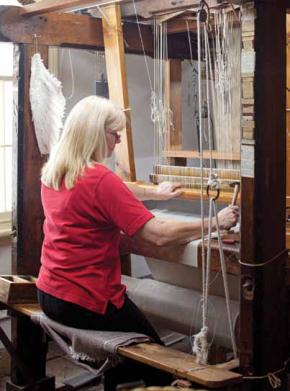
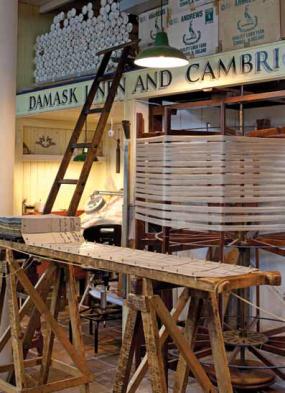
Work begins with an intricate graph-
paper design, opposite. A woman weaves the
delicate threads on an antique loom, left.
On a Jacquard loom, above, the pattern is
formed by holes punched in cards, like those
arranged on the trestle table, below.
victoriamag.com
43